

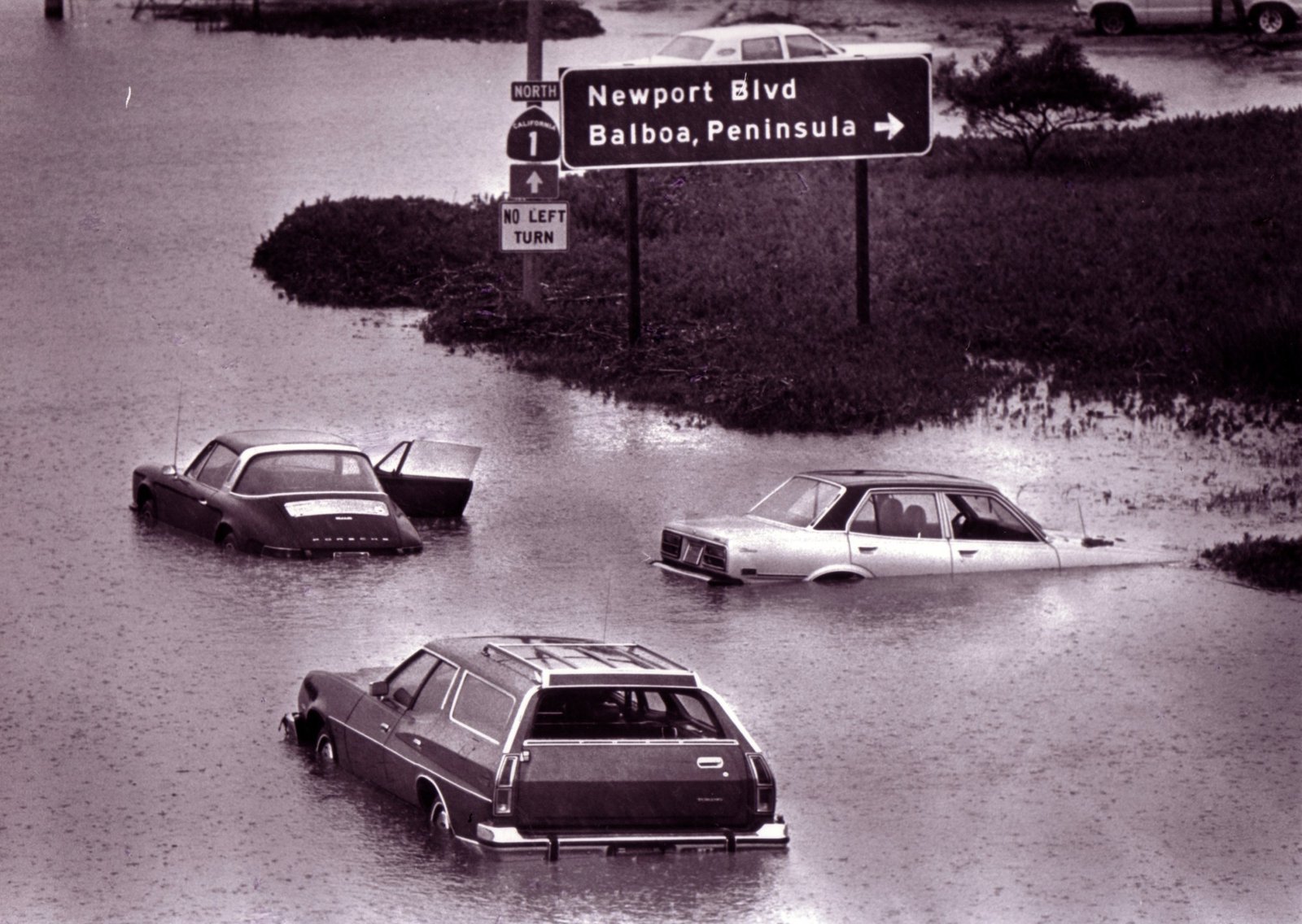
The seawater filling the streets, homes and businesses in recent days in Newport Beach brought back a flood of memories.
Longtime Newport Beach resident Christine Donovan still remembers the El Niño-fueled flood of 1983, more than 40 years ago when she was in eighth grade, and the sight of salt water filling up the bottom of her school bus.
“It’s been a long time since I’ve seen it like this,” the now-real estate broker said on a recent day, watching as the Newport Harbor flowed like a babbling creek into the streets. “We were literally driving down the Peninsula and water was rolling down the aisle in the bus.”
Some say they never dreamed the flooding filling
Some say they never dreamed the flooding filling streets both from both the beach and the bay in the last month could happen.
Others remember days of yesteryear, when similar scenes unfolded: water rising to car doors, soaking living rooms and garages, and always a few who take to the watery roads aboard surfboards or kayaks to bring a lighthearted take on the odd sight.
Flooding that happened in early October was from a strong surf surge that sent waves crashing up and over sand like a rushing river that filled the streets and reached into homes. The flooding last week on the Balboa Peninsula and in other low-lying areas was from a different threat: record water levels during high tide that, almost calmly, sent water spilling over and through seawalls.
Flooding is part of Newport Beach’s storied past.
- 2026: Nick Tingle pulls Gianni Jaha through sea water that flooded on to Balboa Boulevard near 15th Street on the Balboa Peninsula in Newport Beach, CA, on Friday, October 9, 2026. (Photo by Jeff Gritchen, Orange County Register/SCNG)
1 of 7 2026: Nick Tingle pulls Gianni
1 of 7
2026: Nick Tingle pulls Gianni Jaha through sea water that flooded on to Balboa Boulevard near 15th Street on the Balboa Peninsula in Newport Beach, CA, on Friday, October 9, 2026. (Photo by Jeff Gritchen, Orange County Register/SCNG)
Expand
It was actually a flood, ironically, that created parts of the Balboa Peninsula that now sits with the Pacific Ocean on one side, and Newport Harbor on the other.
In 1825, heavy flooding changed the course of the Santa Ana River, at the time flowing through where Newport Harbor currently sits, according to an OC Parks history piece.
The river began emptying into the sea
The river began emptying into the sea in an area now known as West Newport, and sand carried downcoast by the currents and by the river during that rainy season built up the peninsula. In 1861, another flood started silt deposits that later became islands in Newport Bay
As the sand built up, vacationers and developers started eyeing it as prime real estate.
But the problems that come with beachfront living were apparent early on: The peninsula and islands sat lower than the sea when the tides became high.
Early era planners didn’t account for rising sea
Early era planners didn’t account for rising sea levels, or think that future residents would face combinations of conditions the magnitude of which set a record-breaking 8.4-foot tide on Tuesday — the city started keeping records in the 20s.
In the early 1900s, the city came up with a plug system that would help keep the water from coming up through the streets, later upgraded to valves that have to be manually turned every time tides got high to help divert water back to the bay instead of the streets — a system that still exists today.
“There are about 90 valves that get closed during high tides so the water doesn’t come through the streets,” said Mike Alvidrez, the city’s utilities crew chief, while manning a pump spewing out the sea during the recent high tides. Workers start the pumps about two hours before the peak high tide, and continue until about two hours after.
Most of the time, the system works perfectly,
Most of the time, the system works perfectly, and no one even notices the behind-the-scenes effort.
But when you factor in tides high enough for bay water to spill over or through seawalls, or add rainstorms during those peak high tides, flooding happens.
Nearly every decade has had years where salt water met the streets. The Balboa Island Museum & Historical Society has photos showing floods in 1934 on the Balboa Peninsula and the boardwalk, and in 1935 at Balboa Avenue and Grand Canal, and in 1937 at Sapphire Avenue.
Flood events were also recorded in 1969, 1978, 1980, 1983, 1992, 1995, 1997, 1998, 2005, 2010 and 2011, according to city records and Register archives.
In more recent years, water flooded
In more recent years, water flooded from the beach into the street, stranding motorists for hours on Fourth of July in 2020, and again water spilled into streets in 2021 and 2023.
Public Works Director Dave Webb said flooding comes from threells, trapped rainwater when the tide valves are closed due to high tides, and high surf and swells that push water up and over the beach
Longtimers are worried this year, with a “Super El Niño” poised to hit the region, could be reminiscent of the big El Niño storm of 1983, the same season that knocked down piers and other structures and flooded the city streets.
Balboa Ferry operator Seymour Beek, now 93, remembers that year, calling the storm “ferocious.”
A dock in front of his house
A dock in front of his house was knocked down, and small piers around the Balboa Island were damaged.
“The storm event was the killer, it made big waves in the bay and the waves broke over the sea walls,” said Beek, who had to shut his ferry operation to vehicles last week when tides became too high.
It is also becoming apparent that the seawalls weren’t built high enough to withstand modern-day sea level rise. Last week, the city handed out more than 20,000 sandbags to residents to pile on top to add height in lower sections and added wooden planks in some areas in an attempt to hold back the sea.
Five years ago, several seawalls around Balboa Island
Five years ago, several seawalls around Balboa Island were raised by 9 inches. The project cost the city about $1.6 million. And, when a home has a major remodel or is torn down to build a new one, getting a California Coastal Commission permit typically requires raising the property’s seawalls.
But many seawalls on private properties and also some city-maintained ones remain low. Webb said the city can sandbag and bolster its remaining sections. But the city warns residents they must also address their own properties. In the recent flooding, the city stepped in with 21 notices of violations and two $200 citations for homeowners in flood-prone areas, officials said.
Following the swell from the sea a few weeks ago, the city scrambled to build up tall walls of sand to hold back the waves on beaches, makeshift mounds that will likely stay in place through El Niño. The city trucked in sand from the Santa Ana River and Prado Dam.
Whether the sand grains will be any match
But whether the sand grains will be any match for the ocean is yet to be seen.
Resident Dana Smith was one of the homeowners whose house flooded a few weeks ago with the ocean surge. While the flooding only caused drywall damage in the garage, her neighbors’ homes were severely flooded, she said.
“We’re dry right now, we’re good,” she said. “But we’re fortunate; a bunch of our neighbors had to move out, full living rooms, everything, flooded.”
She, too, is looking ahead to Thanksgiving
She, too, is looking ahead to Thanksgiving and Christmas, when king tides are expected. Those are typically the highest tides of the year.
“We’re wondering what the plan is,” Smith said.
If warm-water conditions persist and continue to push water levels a foot or two higher, or Kelvin waves show up at the same time, or storms bring rain, or swell brings surf — any of those combinations with king tides could spell disaster for the holidays.
“If we had a big rainstorm at the same time we had these tides, it would have caused a lot more trouble,” Beek said.
Scott Carpenter was found on a recent day
Scott Carpenter was found on a recent day sweeping seawater from the gutters in front of his rental home, where his tenants had gone on vacation. Day after day, he was sending them photo updates, assuring them their belongings were dry.
He handed out water bottles to city workers who spent countless hours trying to fight back against the sea, thanking them for their hard work.
Carpenter knows, with a forecasted El Niño still on the horizon, it’s going to be a long winter ahead.
We have most days in paradise, and then
“We have most days in paradise, and then we have days like today,” he said. “Everyone is worried about Thanksgiving and Christmas. That’s when the next tide is coming, but I know they will be more prepared this time around.”
These days, Donovan still calls Newport Beach home, but up the hill, away from the water.
“My husband has us up on the bluffs, because he’s from Pennsylvania — this is crazy to him,” she said.
As a real estate broker, Donovan said she
As a real estate broker, Donovan said she knows people will put up with the wet and wild conditions, taking the good with the bad of beach and bayside living.
“I think people are going to tolerate it,” she said, standing just steps from both the bay and the beach. “Because people are going to be in the middle of all of this.”
