

The sandbags are stacked high, with hopes of being a buffer against rising seawater. Berms on the beach have been built into walls to defend against the ocean’s waves. Crews and homeowners are watching, ready to jump into action if flooding starts to wreak havoc.
But even with weeks to prepare against this upcoming round of king tides — super-fueled by warm water conditions from an El Niño and other factors — will preparations be enough to hold back the mega high tides threatening the coast?
Tide levels are rising for the week, with king tides — according to cycles of gravitational pull — Nov. 24-26, and if the rising water finds a way to breach seawalls, sandbags and berms built up as a defense, flooding could be seen up and down the Southern California coastline.
Water levels are expected to reach near 9
Water levels are expected to reach near 9 feet at the highest tides of the day in the morning hours during the king tides, poised to break records set just a few weeks ago in October.
But that recent flooding into streets, homes and businesses was a wake-up call, a chance for governments and homeowners to better prepare — and to assess if long-term planning for sea level rise needs to speed up.
Adding to the troubles this coming week is a sizable swell hitting the region, which could cause flooding and damage like was seen in Newport Beach and Long Beach in early October and Seal Beach just last week when waves breached berms. High tide and swells together could further damage already battered beachfront homes in Long Beach, Laguna Beach and Dana Point.
Early forecasts also indicate some rain
Early forecasts also indicate some rain on the horizon, potentially creating a trifecta of mess that could further back up flooded water onto streets.
City officials in Newport Beach said they feel comfortable with their preparations for what could be record-breaking high tide levels this year.
With lessons learned from October, they said city staff have worked with residents to identify hazard zones in the city’s low-lying areas where water might not have gotten in before, but could now in light of higher water levels.
At the shoreline and in low-lying areas around
At the shoreline and in low-lying areas around the Balboa Peninsula and the smaller harbor islands, Mark Vukojevic, the city’s utilities director overseeing preparations, said crews have built and reinforced approximately 5.3 miles of sand berms, distributed 150,000 free sandbags, and raised the height of 70 public seawalls throughout the community.
Crews are also inspecting stormwater infrastructure, maintaining tide valves and pumping systems, and positioning equipment in flood-prone areas.
Oceanfront and harbor residents around the region are encouraged to keep building up their sandbag fortresses in areas that could be threatened by water intrusion, including low seawalls, garages, doorways, and other openings. They should also check their private drains and tide valves for potential backflow. One property not properly secured could flood neighbors.
Another renting a pump to help manage minor
Another renting a pump to help manage minor leaks and pump water back into the harbor.”
Residents are also reminded to move vehicles — especially electric vehicles, golf carts, and e-bikes — to higher ground.
In Newport Beach, the city is suspending parking enforcement south of Pacific Coast Highway and in the Sunset Ridge Parking Lot at 100 Superior Ave. for the week, starting Sunday, Nov. 22, at 6 p.m. through Friday, Nov. 27, at 6 p.m.
Huntington Beach officials have spent the last few
Huntington Beach officials have spent the last few weeks reinforcing seawalls and bulkheads in Huntington Harbor with sealant and three levels of plastic-wrapped sandbags to prevent seawater that has been spilling onto PCH and into the Surfside community.
The city has set out 20 inflatable air bladders and 130 more flood barriers, two 40-yard dumpsters and several 4-inch pumps to prepare for the king tides, Public Works Director Chau Vu said.
The city has also set up 15 storm drain pump stations throughout the harbor area and established four sandbag pickup locations at the Corporate Yard, Edison Community Center, Meadowlark Golf Club and Warner Fire Station.
Road closures are planned from 6 a.m
Road closures are planned from 6 a.m. to 2 p.m. Monday through Friday, though times may change based on tide conditions, weather and public safety needs. Pacific Coast Highway will be closed from Seal Beach Boulevard to Warner Avenue in both directions, with several other closures going both directions along smaller streets in low-lying areas.
The city has sent initial code enforcement notices to 113 coastal homeowners, informing them of the need to barricade their properties with sandbags and flood prevention barriers. More than 80% of homeowners have complied, officials said.
Mayor Casey McKeon emphasized that no citations have been issued.
“That ordinance wasn’t intended to fine homes,” he said. “It’s just an enforcement mechanism to get people to fortify their homes.”
At Beach Road in Dana Point, where homes
At Beach Road in Dana Point, where homes have suffered battering since summer brought a throng of hurricane swells, homeowners have continued to place big rock boulders in front of their properties as a hopeful protection.
“We’re watching the forecast closely,” said Donal Russell, general manager for the Capistrano Bay District homeowners association.
Like other coastal areas, work has to be timed around when tide levels drop low enough to access the areas underwater during higher tides. Trucks and excavators are entering the beach through now-empty lots where homes stood just months ago before being torn down due to damage from the sea.
“We’re just playing chase,” Russell said.
In total, 10 homes were red-tagged, with three
In total, 10 homes were red-tagged, with three already demolished and one more likely soon, he said. Another 14 are yellow-tagged.
“Those aren’t likely to change until in the spring, when El Niño is over,” he said. “The city doesn’t want to go back and forth with tagging the houses. You never know from one day to the next what’s going to happen with the surf.”
In addition to the boulders, houses have been boarded up with wood planks on the windows, he said.
In other parts of Dana Point, city crews
In other parts of Dana Point, city crews have been delivering sandbags around town and checking in on known trouble spots, along with routine maintenance on the drainage system, said city spokesperson Jessica Spaulding.
On Coast Highway, where there was a minor slide about a week ago, a small wall on the slope side of the drainage inlet to prevent debris from entering the storm drain is being built, with a K-rail to be installed to keep debris from flowing into the street.
The California Department of Transportation is monitoring coastal conditions near roads in preparation for the upcoming King Tides.
The potential for rain, combined with elevated tide
The potential for rain, combined with elevated tide levels, could increase the risk of flooding along Pacific Coast Highway in low-lying coastal areas, including Newport Beach, Huntington Beach, and Seal Beach.
Maintenance crews are also preparing for the possibility of high tides causing the Bolsa Chica wetlands and Sunset Beach canals to overflow onto PCH, Caltrans officials said in an alert. “Depending on weather, tidal, and ocean conditions, temporary road closures along PCH may be necessary to protect drivers and road infrastructure.”
At Pacific Coast Highway in Huntington Beach, maintenance crews are installing bladders from 8th to 17th streets to prevent flooding, said Christianne Smith, spokesperson for Caltrans.
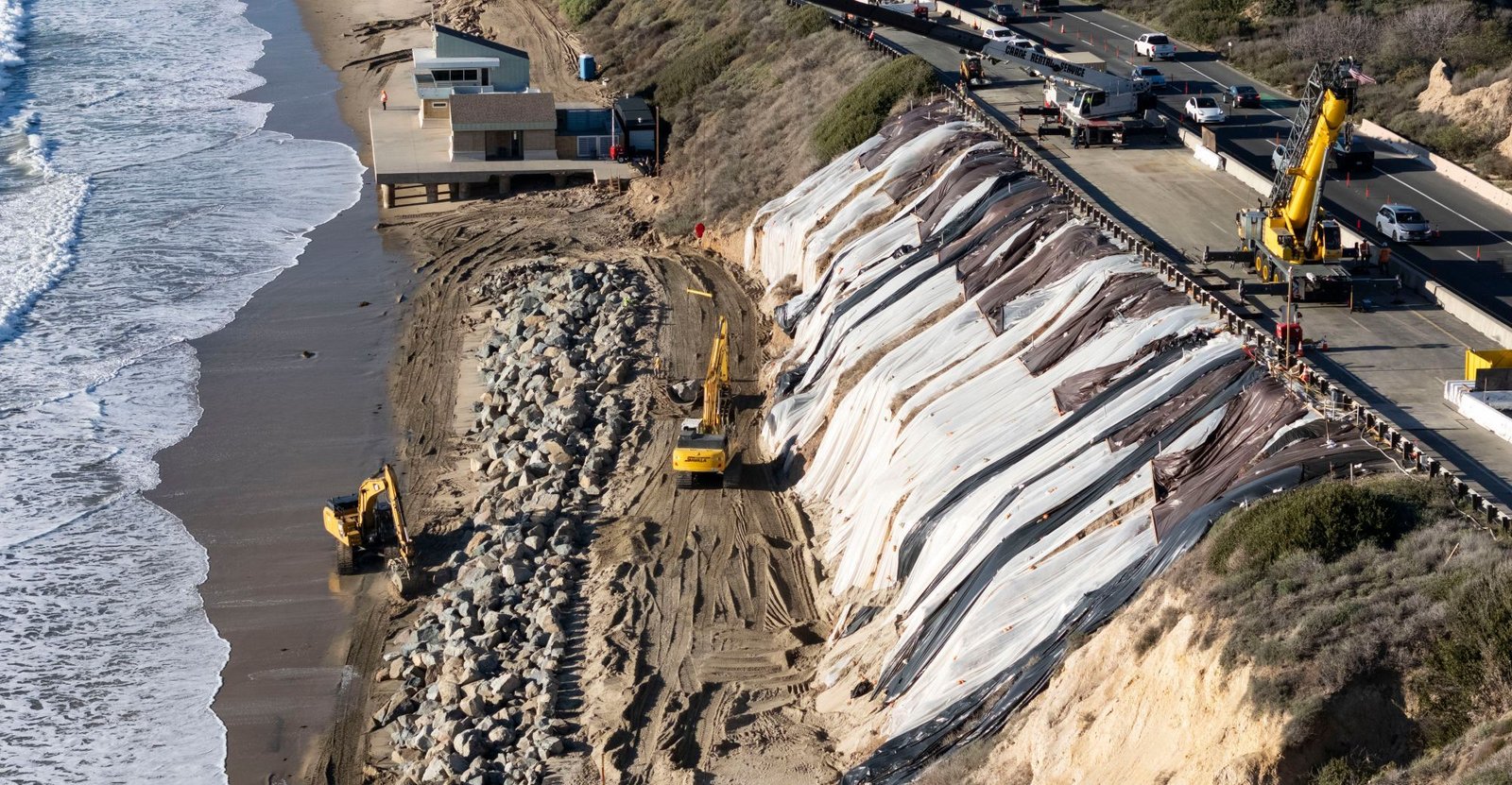
At the site of a large crack
At the site of a large crack on a Crystal Cove State Park bluff at El Moro under Pacific Coast Highway, Caltrans has finished installing a 12-foot-tall sandbag barrier, and work is nearly complete placing large rocks along the perimeter of that sand barrier as a buffer between the bluff and the waves, Smith said.
The crack remains covered in plastic sheeting to prevent rainwater from entering the slope, she noted. The protective measures held up during recent rain, Smith said.
“We continue to monitor the slope for movement and any changes to its condition daily through survey prisms, in-person surveys, and drone imagery,” she said in an email. “There are no newly visible slope changes.”
In Laguna Beach, berms are up at Main
In Laguna Beach, berms are up at Main Beach to prevent flooding onto Coast Highway. Aliso Beach, which suffered damage through summer from hurricane swells, remains closed.
The city’s lifeguards are patrolling the beaches to make sure people aren’t putting themselves in precarious places, Marine Safety Chief Kai Bond said. “We have looky-loos that come out, but we want to combat that and keep people safe.”
City Manager Dave Kiff said the city is well prepared for El Niño storms that are forecast for this winter.
They don’t see aligned with the king tides,
“They don’t see aligned with the king tides, at least for Thanksgiving,” he said, crossing his fingers.
In Seal Beach, large surf and high tides can combine to breach the berm and flood into the streets, as happened last weekend. Crews scrambled to rebuild the wall of sand even higher in the days following in anticipation of the king tides.
While the efforts can reduce risk, “they cannot eliminate the possibility of flooding during extreme conditions,” city officials warned residents in an email alert.
Dave Eggie, of Long Beach, couldn’t help
Dave Eggie, of Long Beach, couldn’t help but take video of the big, 20-foot walls of sand crews built along Seal Beach earlier this week during his regular dog walk outing.
“I’ve never seen it that high,” he said. “You can see it’s massive, compared to what they’ve done in the past.”
At the Crystal Cove cottages, work hasn’t stopped since high tides and surf battered the beach and some of the historic structures in October, prompting an evacuation of some of the overnight guests a month ago, said State Parks Superintendent III Paul Andrus.
Berms have been built, sandbags positioned and large,
Berms have been built, sandbags positioned and large, 4-by-4-foot sand cubes now span about 650 feet in front of the historic district ahead of next week’s tides.
Crews are also using a new 3-foot-long flood barrier device that should help guide water away from structures. Heavy equipment will be on hand daily to rebuild sand berms if needed, Andrus said.
There’s no anticipation of canceling reservations, he said, with a water main break fixed and a big sand berm built to protect the cottages, which are a popular place to stay in the State Parks system.
“We think with the sand berms and all the other preparatory work we are doing, it won’t lead to that,” he said. “But we will monitor and respond if needed.”
