


Mortgage interest rates are gradually creeping up.
When I took out my loan in 2023, the rate was 0.6%, including coverage for eight major illnesses.
That rate has now risen to 1.25%.
It is not yet at a level that makes repayment difficult.
However, I have been thinking about it a lot lately.
“If this rate hits 3%, wouldn’t it be better to make early repayments rather than continue investing?”
This time, I took this question quite seriously with my AI My FP.
If you had 10 million yen right now, would you pay it off or invest it?
My current mortgage balance is approximately 40 million yen.
I had vaguely thought,
“Once it hits around 3%, I’ll probably make an early repayment.”
I thought that.
So, in the middle of my exchange with the AI, I posed this question:
“If you had 10 million yen in disposable cash right now, would you pay off your mortgage or invest it?”
I thought about it for a moment.
If it were me right now—
I would invest it.
One of the reasons I thought that was because of my own brokerage account.
The current valuation is approximately 5.08 million yen.
The unrealized gain is about 780,000 yen.
The unrealized gain/loss ratio is +18.07%.
Looking at this, I can’t help but think.
“If the mortgage rate is 3%, wouldn’t it be better to keep investing than to pay it off?”
However, there was one problem with this way of thinking.
+18.07% is not an annual rate.
+18.07% is the unrealized gain/loss ratio currently displayed as a result of my investments so far.
It does not mean that I am managing my investments at an annual rate of 18.07%.
The timing and amounts of the investments are not the same.
On the other hand, the 3% mortgage rate is an annual rate.
Therefore,
“+18.07% > 3%”
comparing them simply like this was strange in itself.
What is even more important is the future, not the past.
If you are going to compare it with the mortgage interest rate,
“how much it has increased so far”
instead of,
“what kind of annual return you expect from now on”
you need to think in terms of that.
Moreover, investment returns are not guaranteed.
There will be years when it is positive, and years when it is negative.
At this point, the initial simple comparison fell apart.
To begin with, can a “3% mortgage rate” be taken at face value as 3%?
Next, what I broke down with the AI was the mortgage interest rate itself.
In my case, the displayed interest rate includes the +0.3% for the 8 major illness coverage I chose myself.
To me, this 0.3% has a slightly different nature than just a borrowing interest rate.
It is a “cost of buying coverage” that I chose to pay for to prepare for emergencies.
Furthermore, I am currently receiving a mortgage tax deduction as well.
So, I tried thinking about it by dividing it into:
The mortgage interest rate itself
The cost of illness coverage
The mortgage tax deduction
I tried thinking about it by dividing it into these parts.
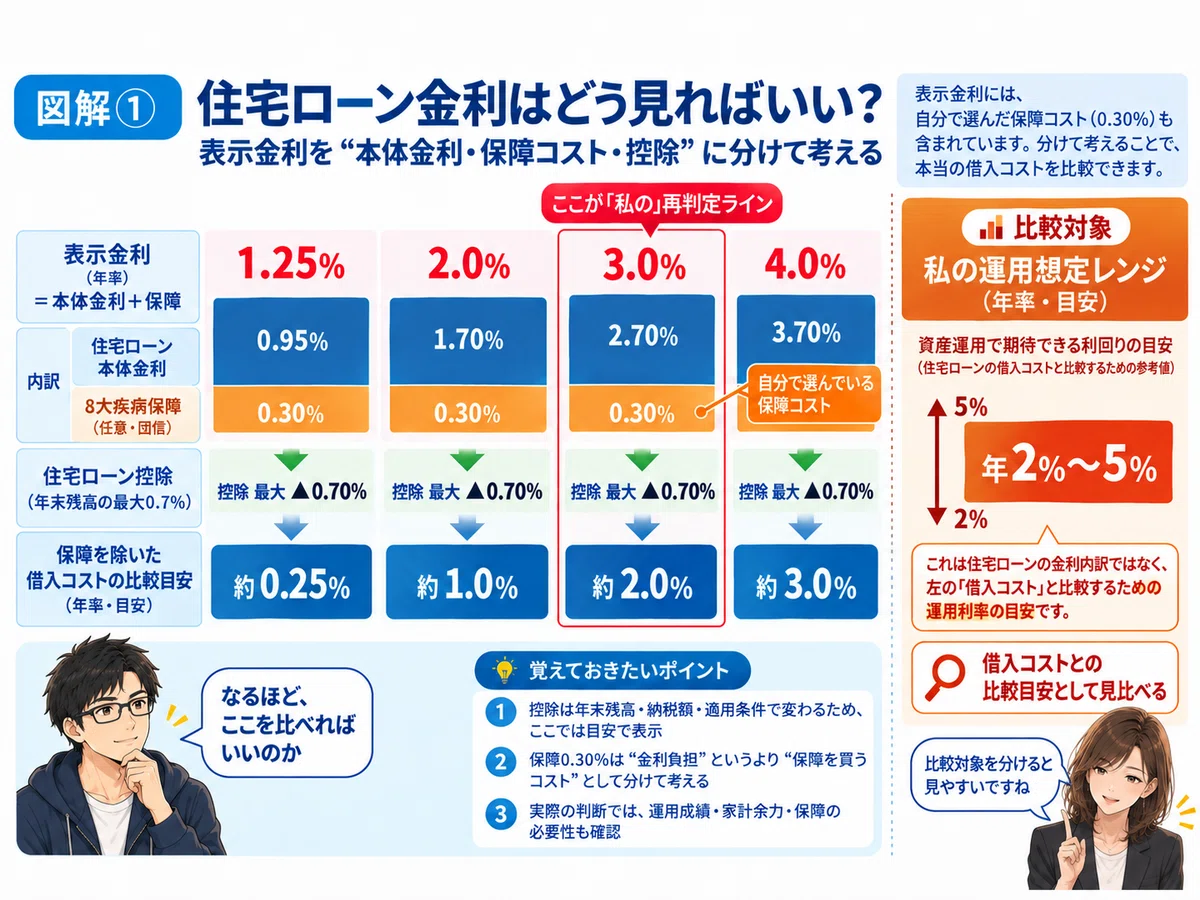
Breaking down the mortgage interest rate and comparing it with the assumed investment range
For example, if the displayed interest rate becomes 3%.
In my case, I view it as:
Mortgage principal 2.7%
+ 8 major illness coverage 0.3%
= Displayed interest rate 3.0%
I view it as this.
Furthermore, if we consider the 0.7% mortgage tax deduction strictly as a benchmark for comparison,
The comparative benchmark for borrowing costs, excluding insurance, is approximately 2%.
However, caution is needed here.
This does not mean that the “real interest rate will definitely be 2%.”
The mortgage tax deduction varies in effectiveness depending on the year-end balance, actual tax amount, and applicable conditions.
For the certified low-carbon housing I moved into in 2023, according to the National Tax Agency’s guidance, the deduction period is 13 years, each year is calculated as year-end balance, etc. multiplied by 0.7%, and the deduction limit is 350,000 yen.
National Tax Agency
Therefore, the figures in the chart are
a “comparative benchmark” for considering whether to continue investing or make early repayments
that I decided to use.
Why 3% is “my re-evaluation line”
On the other hand, regarding asset management, I did not fix future returns to a single number, but instead
set a range of about 2-5% per year
as an assumed range for comparison.
This is neither a prediction nor a guarantee.
Since it is an investment, there is naturally a possibility of negative returns.
But when the mortgage rate reaches 3%,
the comparative benchmark for borrowing costs that can be reduced through early repayment: approximately 2%
and
the expected investment return by taking risks: approximately 2-5% per year
begin to overlap at the lower end.
At this point,
it becomes hard to say
that “continuing to invest is definitely more profitable.”
However,
it is not necessarily the case that you should
“repay immediately once it hits 3%.”
Therefore, I have decided
not to repay when it hits 3%,
but rather
to seriously compare the options again once it reaches 3%.
3% is
“my” threshold for re-evaluation.
This feels the most right to me for now.
But there is one more thing to consider regarding early repayment.
Up to this point,
it has only been a matter of
mortgage interest rates versus investment returns.
But in my case, there is one more factor.
Coverage for the eight major diseases.
I chose this coverage myself when I took out my mortgage.
With a current remaining balance of approximately 40 million yen, a simple calculation of 0.3% comes to about 120,000 yen per year.
That is about 10,000 yen per month.
It is by no means a small amount.
On the other hand, SMBC’s information states that the mortgage balance becomes zero if certain conditions are met regarding eight major illnesses. Since the conditions differ for each illness, it is not a case of ‘everything becomes zero if you get sick.’ Even in current SMBC materials, the guidance is mortgage interest rate + 0.3% per year.
SMBC +1
That led to a new question.
Is making early repayments to reduce the remaining balance truly only beneficial?

Early repayment brings peace of mind. But that remaining balance is also the basis for the coverage.
The mortgage balance is, of course, a debt.
It feels safer to have less of it.
However, in my case, since I have illness coverage, the same remaining balance has another aspect.
It is also the basis for the amount that can be covered in the event that certain conditions are met.
In other words, if you make an early repayment,
the interest you pay decreases.
On the other hand,
the remaining balance protected by the illness coverage also becomes smaller.
‘Reducing debt’ and ‘reducing coverage’ happen at the same time.
Thinking about it this far, I can no longer decide based on interest rates alone.
Even at the same 3%, the answer differs from person to person.
So, what exactly should you look at to make a decision?
What became important here was
“what kind of situation I am in at that time”
.
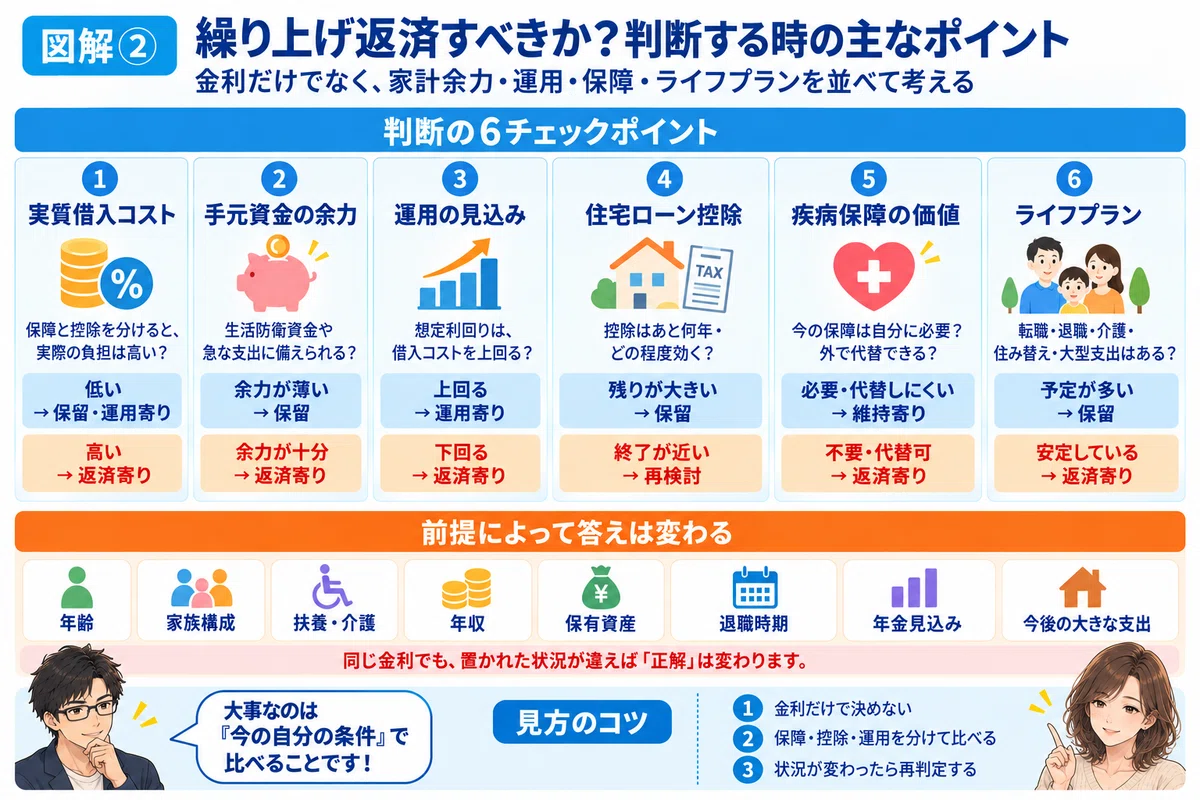
Should you make early repayments? Key points for making a decision
I decided to look at six main factors.
Borrowing costs.
Available cash on hand.
Future investment prospects.
Mortgage interest deduction.
The value of disease insurance coverage.
Life plan.
Furthermore, in the background of that, there are
age, family structure, dependents, nursing care, annual income, assets held, retirement timing, pension prospects, and major future expenses.
For example, even at the same 3%,
someone in their 40s who will work for a long time versus someone nearing retirement.
Someone with sufficient financial assets versus someone with little spare cash.
Someone with few major planned expenses versus someone facing relocation or nursing care.
The answer is not necessarily the same.
Ultimately,
There is no universal number for the question, “At what percentage should I pay it off?”
So, what will I do now?
After thinking this through with AI, I have made my current decision.
At the current 1.25%, I will not make early repayments.
I will continue to invest.
However, the reason is not,
“Because my investments are up 18.07%.”
It is not that.
The cost of the mortgage itself.
The mortgage interest deduction.
The disease insurance I chose myself.
Available cash on hand.
The time I have left to invest.
My future income.
And my future life plan.
After weighing all of these,
I have decided that for now, rather than rushing to reduce my mortgage, I will continue to build assets while keeping cash on hand.
That is what I have decided.
It is not a case of “I will pay it off if it hits 3%.” I will decide again when that time comes.

I will decide again as the person I am at that time.
At first, what I wanted to ask the AI was,
“At what mortgage interest rate should I make early repayments?”
That was it.
However, what I ended up with was not a definitive number.
It was my own decision-making rule.
I will not pay it off now.
I will set 3% as my “re-evaluation threshold.”
And when it reaches 3%,
interest rates, remaining balance, insurance, investments, assets, income, pension, family, and future expenses.
I will lay out the conditions at that point once again.
As a result,
if I decide for myself that it is better to pay it off, I will do so then.
There is no need to pay it all off.
There is also the option of making partial early repayments.
It is not that the AI decided the correct answer for me.
By thinking together with the AI,
“what I need to look at to make a decision”
became clear.
That was the biggest takeaway this time.
If interest rates change, I will recalculate.
Even if your situation changes, recalculate.
And in the end,
decide again as the person you are at that time.
With AI My FP, I have gradually developed my own criteria for judgment.
Recently, when I consult AI about money,
the way I use it to
“get the right answer” has decreased.
When to sell stocks.
Is it okay to build a house again?
How to allocate assets.
Whether to pay off the mortgage early.
None of these have a universal answer for everyone.
That is why I
create my own judgment criteria by changing the conditions with AI many times.
I have started using it that way. I want to design my judgment criteria while organizing my life choices and priorities at that moment.
▶ Related article: I couldn’t even tell an AI. I tried consulting my own personal ChatGPT FP about wanting to build a house again
▶ Related article: After continuing to consult an AI about stocks and money, even my asset management changed.
Next is “How I am building my AI My FP”
Having read this far,
“To begin with, what exactly are you inputting into AI My FP?”
Some of you might be wondering that.
Next,
what am I telling the AI?
What kind of prerequisites am I setting?
How much do I let the AI think for itself?
Where do I start verifying things myself?
I would like to organize how to build the “Personal AI My FP” that I actually use.
*This article summarizes the process I went through to think about my own mortgage and asset management. It does not recommend any specific financial products or investment actions. Since conditions for mortgage deductions and illness coverage vary depending on contract details, move-in dates, tax amounts, etc., please check the latest systems and contract details when making actual decisions.
