

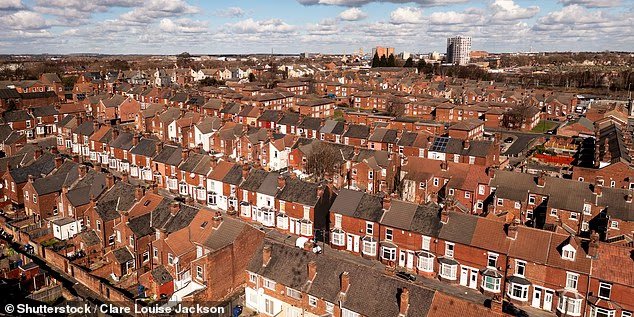
Mortgage rates have been heading higher in recent weeks as concerns grow over the future direction of inflation and interest rates.
All the biggest lenders have re-priced home loan deals higher this month, some more than once.
That’s despite the Bank of England holding base rate at 3.75 per cent on September 17 for the sixth consecutive time since December 2025.
However, higher oil prices, renewed inflation and a global bonds sell off has rattled financial markets meaning many expect interest rates are back on the rise.
Investors are now betting that rates will jump from the current rate to 4.75 per cent by this time next year and potentially as high as 5 per cent.
This all has implications for fixed rate mortgage pricing right now.
While there are still fixed-rate mortgage deals below 5 per cent, more and more are being repriced above the 5 per cent threshold.
In fact, the average five-year is at its highest since October 2023, according to Moneyfacts.
In terms of the market average. The average two-year fixed rate mortgage was 4.83 per cent at the start of March. That’s now climbed to 5.84 per cent. Meanwhile the average five-year fix is now 5.88 per cent, up from 4.95 per cent in early March.
> Best mortgage rates calculator: Check the deals you could apply for
Mortgage rates: What’s happening
Rather than following the base rate, fixed mortgage rates are largely based on Sonia swap rates, which track future interest rate expectations.
Mortgage lenders enter into these swap agreements with other financial institutions to shield themselves against the interest rate risk involved with lending fixed rate mortgages.
Sonia swap rates are influenced by long-term market projections for the Bank of England base rate, as well as the wider economy, internal bank targets and competitor pricing.
Put simply, they create a benchmark of where the market thinks interest rates will go – though they can shift quickly in light of economic changes.
The problem is, when Sonia swap rates go up, the cost of borrowing increases for lenders, which is then passed to homeowners in the form of higher mortgage rates.
Last week, five-year swaps hit 4.78 per cent, up from 4.28 per cent in August. Meanwhile two-year swaps were at 4.7 per cent, up from 4.17 per cent.
The spike in Sonia swaps has resulted in many lenders upping rates. Major banks including NatWest, Santander, HSBC, Lloyds Bank and TSB all announced increases within hours of each other last week.
Will mortgage rates go up or down?
Fixed rate mortgage pricing is being pushed around by inflation expectations, swap rates, and the cost of funding and what the Bank of England is expected to do with base rate.
At present it certainly doesn’t look like mortgage rates are coming down anytime soon based on all those factors.
Inflation was up 3.1 per cent in the 12 months to August, according to the latest figures from the Office for National Statistics.
Higher petrol prices are expected to push headline Consumer Prices Index to 3.4 per cent in next month’s data, before another uptick in October when the energy price cap increases by 4 per cent.
But early forecasts for the energy price cap in January suggest bills could rise by 25 per cent, adding a potential further headache to policymakers.
That means mortgage borrowers cannot afford to sit back and wait for a neat base rate cut to solve the problem.
For households approaching their remortgage, that means reserving a new rate ahead of the current deal expiring – this can often be done up to six months before your current deal ends.
For people looking to take out a mortgage in order to buy a home it means using higher rates to your advantage and negotiating a big discount off the asking price. Higher rates means there may well be less competition for the types of properties you’re looking to buy.
Going up again: The average five-year fixed rate mortgage has hit its highest level since October 2023, the latest data from Moneyfacts shows.
Should you fix for two or five years?
Choosing what length to fix for depends on what you think may happen to interest rates but should importantly take more account of what your personal circumstances are.
Key factors include whether you may move soon, how much you prefer the security of fixed payments for longer and how well you could cope with a rise in mortgage bills.
Fixed rates of any length offer borrowers certainty over what their payments will be from month-to-month.
Those opting for a shorter two-year fix are backing interest rates falling over the next couple of years, or at least staying steady, so that when it is time to remortgage their bills won’t rise.
With five-year fixes borrowers are locking into rates that they know won’t change for longer, perhaps either because they believe rates may rise or because they prefer the security. Five-year fixes were hugely popular when rates were lower.
If rates fall, a tracker mortgage without an early repayment charge could put borrowers in a position to take advantage.
However, for all the potential benefit, a tracker product will also leave people vulnerable to further base rate hikes, while also being more expensive than fixed rates at present.
Whatever the right type of mortgage for your circumstances, shopping around and speaking to a good mortgage broker is a wise move.
> Check the best mortgage rates based on your house price and loan size
What are the best mortgage rates?
We have taken a look at the best deals on the market based on a 25-year mortgage for a £290,000 property – the current average house price, according to the ONS.
The mortgage deals below are best in terms of having the lowest rate.
They may not be the cheapest deal overall when arrangement fees are also factored in.
Bigger deposit mortgages
Five-year fixed rate mortgages
Barclays has a five-year fixed rate at 4.77 per cent with a £948 fee at 60 per cent loan to value.
First direct has a five-year fixed rate at 4.84 per cent with a £490 fee at 60 per cent loan to value.
Two-year fixed rate mortgages
Barclays has a 4.69 per cent two-year fixed rate deal with £948 fees at 60 per cent loan-to-value.
First direct has a two-year fixed rate at 4.84 per cent with a £490 fee at 60 per cent loan to value.
Mid-range deposit mortgages
Five-year fixed rate mortgages
First direct has a five-year fixed rate at 4.99 per cent with a £490 fee at 75 per cent loan to value.
HSBC has a five-year fixed rate at 5 per cent with a £998 fee at 75 per cent loan to value.
Two-year fixed rate mortgages
Barclays has a two-year fixed rate at 4.75 per cent with a £948 fee at 75 per cent loan to value.
First direct has a two-year fixed rate at 4.96 per cent with a £490 fee at 75 per cent loan-to-value.
Low-deposit mortgages
Five-year fixed rate mortgages
First direct has a five-year fixed rate at 5.26 per cent with a £490 fee at 75 per cent loan to value.
HSBC has a five-year fixed rate at 5.27 per cent with a £998 fee at 75 per cent loan to value.
Two-year fixed rate mortgages
Lloyds Bank has a two-year fixed rate at 5.38 per cent with a £999 fee at 90 per cent loan to value.
First direct has a two-year fixed rate at 5.39 per cent with a £490 fee at 90 per cent loan to value.
Tracker and discount rate mortgages
The big advantage to a tracker mortgage is flexibility. They are also slightly cheaper following the rise in fixed rates.
Tracker mortgages essentially track the Bank of England base rate, plus a percentage. For example, base rate (3.75 per cent) plus 0.5 per cent giving an overall rate of 4.25 per cent.
Tracker mortgages also have a rather unique feature in that they tend to come without early repayment charges and can therefore be paid off or switched away from without penalty.
The lowest two-year tracker deal is currently offered by Halifax and Lloyds at 4.06 per cent and a £1,499 fee. That’s base rate plus 0.31 per cent.
On a £200,000 mortgage being repaid over 25 years that would equate to paying £1,063 a month.
Nationwide is also offering a 4.13 per cent tracker deal with £798 fees.
There may also be cheaper rates to be had with discount rate mortgages, which track a certain level below the lenders’ standard variable rate.
A fixed-rate mortgage will almost inevitably carry early repayment charges, meaning you will be limited as to how much you can overpay, or face potentially thousands of pounds in fees if you opt to leave before the initial deal period is up.
You should be able to take a fixed mortgage with you if you move, as most are portable, but there is no guarantee your new property will be eligible or you may even have a gap between ownership.
Many tracker deals have no early repayment charges, which means you can up sticks whenever you want – and that suits some people.
Make sure you stress test yourself against a sharper rise in base rate than is forecast.
