

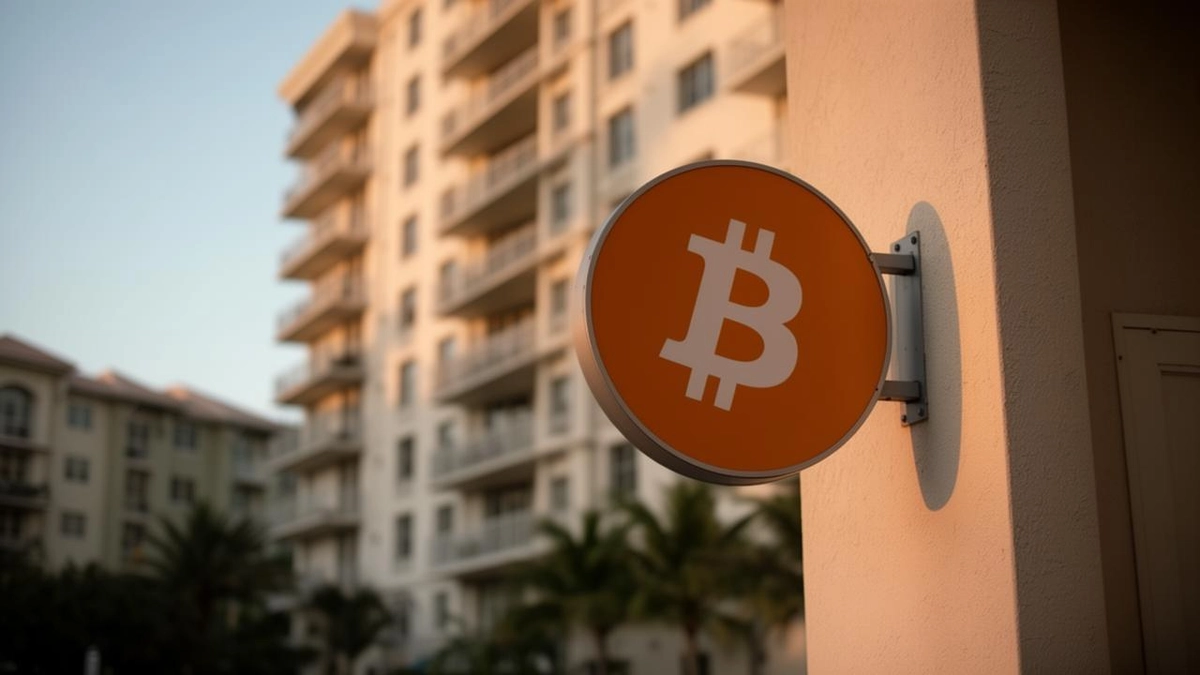
Commercial real estate is heading into a historic repricing that will force institutions to unload properties below replacement cost, and the answer for one veteran investor is to bolt Bitcoin onto every building he buys.
Grant Cardone, founder of Cardone Capital, said the sector faces “almost Armageddon conditions” as five-year all-in borrowing costs of roughly 6.4% cap what buyers can pay. The firm is already working through a $600 million transaction that had to be repriced, he said in a Friday interview.
“Complete reset across the board of commercial real estate,” Cardone said.
He estimated that a trillion dollars of commercial loans mature within six months, forcing the institutions holding them to unwind much of their property. Cardone Capital currently owns 16,000 apartments and half a million square feet of office space.
The investor’s strategy is to treat the discount between a building’s former value and its sale price as an opening to add Bitcoin to the balance sheet. He described the cryptocurrency as a “complementary asset” that functions differently from physical property.
“We build a gap with what we believe is a better asset, which is a complementary asset, maybe a better way to say it, which is Bitcoin,” he said.
Two Assets That Fail Differently
The pairing works, in Cardone’s telling, because the two assets fail in opposite directions. Real estate generates cash flow but cannot be sold quickly. Bitcoin trades around the clock and swings sharply. Holding both provides a hedge against the weaknesses of each.
Bitcoin “doesn’t have gutters and roofs and termites and tenants and evictions and legal problems,” he said. “It just sits there to solve future problems.”
Cardone has been building that position deliberately. The firm holds 3,000 BTC and is targeting 25,000 coins alongside 25,000 apartments, with every property acquisition bringing more crypto onto the books.
“I need 10 deals, 10 Trojan horses,” he said. “My real estate’s the Trojan horse. It’s how I bring the Bitcoin to the party.”
One recent transaction involved paying cash for a Boca Raton asset and adding $100 million of Bitcoin to it. The two source accounts differ slightly on the property’s price, with one citing $235 million and another $335 million.
The REIT Moat
Cardone argued the strategy is difficult for competitors to copy for structural reasons. Real estate investment trusts must distribute 90% of income to shareholders and cannot hold cryptocurrency on the balance sheet.
“There’s a $4 trillion REIT industry that controls most of the real estate in this country,” he said. “They can never ever own Bitcoin or have Bitcoin on their balance sheet. So I have a moat around my business.”
He stopped short of saying whether Cardone Capital itself would go public, noting only that the combination of large-scale property holdings and significant Bitcoin reserves would be hard for imitators to reproduce.
Housing Market Spared
The commercial collapse Cardone predicts does not extend to single-family homes. More than half of US mortgages carry rates below 4% with roughly 23 years remaining, giving owners little reason to sell and supporting prices in the near term.
“This is when the brave get rewarded,” he said. “But it will be painful. I’m walking on glass right now.”
Bitcoin’s price was trading flat over the past 24 hours. On Stocktwits, retail sentiment around BTC remained in the bullish zone, while chatter stayed at normal levels over the past day.
