

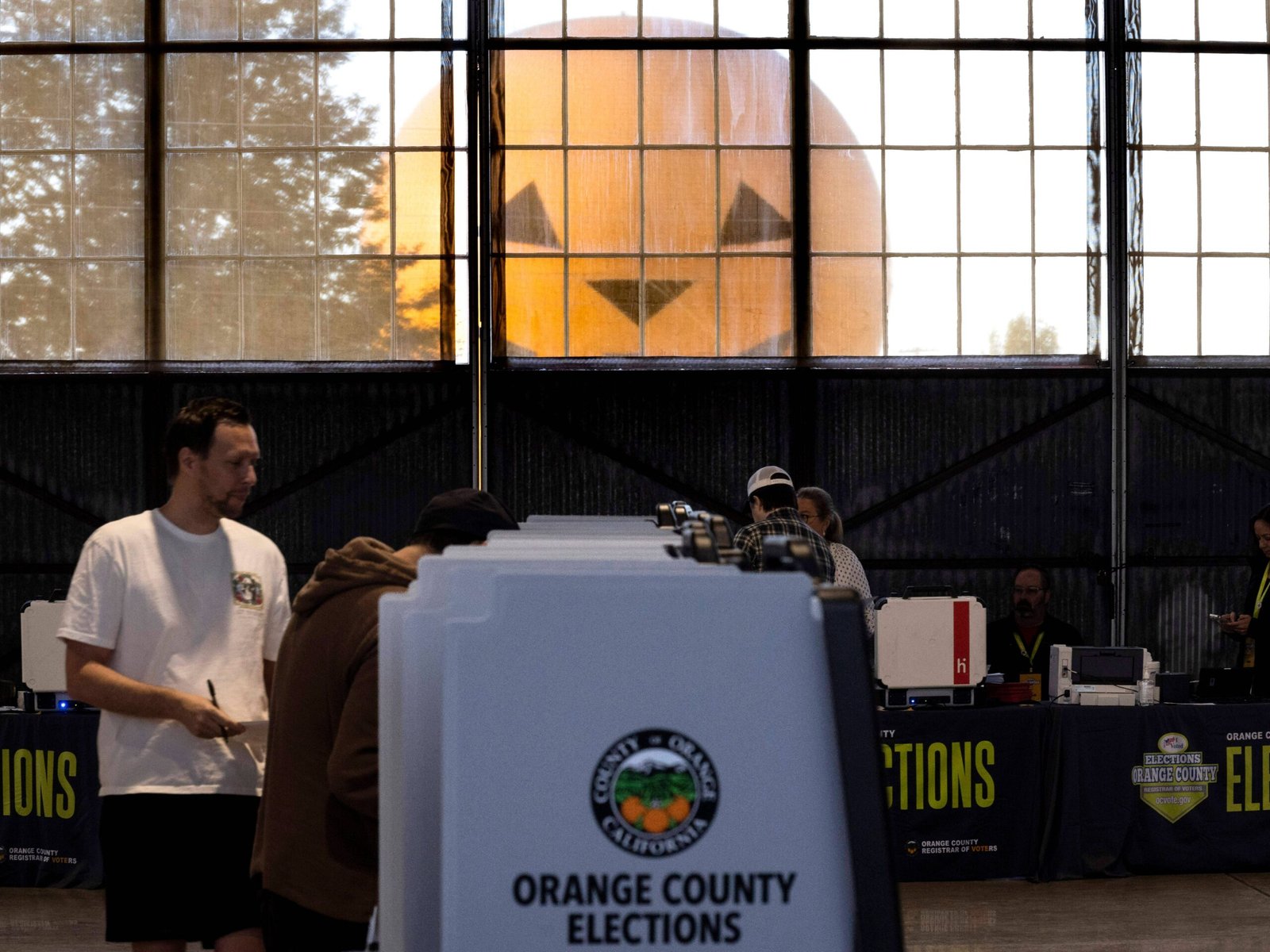
Orange County election officials are “evaluating the requests” made by the U.S. Department of Justice to help determine the citizenship status of 1,754 people.
Bob Page, Orange County Registrar of Voters, said Monday, Oct. 26, that two federal agents hand-delivered a letter and a data storage drive after the DOJ previously had delivered them to a county official who does not oversee elections.
“County Counsel is evaluating the requests in the USDOJ letter and federal and state law. I plan to provide a response by Wednesday’s deadline,” Page said in a statement.
When Page emailed his statement Monday, he attached
When Page emailed his statement Monday, he attached the letter from the DOJ. It appeared to be similar to the one hand-delivered Friday to Orange County Clerk-Recorder Hugh Nguyen but with Monday’s date and now addressed to Page.
The letter asked for help determining the citizenship status of 1,754 people it had identified as “likely aliens” within 48 hours. Nguyen also received a USB drive containing a list of the 1,754 people in question.
For those whose citizenship cannot be determined, the federal government asked that election officials “segregate — not cancel — those individuals’ vote-by-mail ballots until their citizenship status can be determined,” First Assistant U.S. Attorney Bill Essayli said in the letter obtained by The Orange County Register.
In a letter Saturday, Orange County counsel told
But in a letter Saturday, Orange County counsel told Essayli that the Justice Department had “mistakenly sent” the letter and the USB drive — which “may contain confidential, sensitive, or otherwise protected information” — to Nguyen, since the Page’s office is responsible for conducting elections and maintaining voter registration records.
County counsel said in its letter that Nguyen retained the USB drive “in a secure manner” pending DOJ instructions, asking whether a Justice Department official should retrieve it in person or if it should be sent back to DOJ by mail.
As of Monday afternoon, before Page received the letter and the USB drive from federal agents, Orange County officials had not formulated a specific approach in terms of responding to the DOJ’s letter, its 48-hour timeline, whether to comply or how to do so, Page said at the time.
This is a deadline that’s not enforceable; it’s
“This is a deadline that’s not enforceable; it’s just a deadline they’re saying in their letter,” he said. “Bottom line is, we don’t want non-citizens to be voting in this election, but at this point we don’t know how reliable their list for Orange County is. We haven’t had a chance to look at it.”
Also on Monday, the Ninth Circuit Court of Appeal declined to rule on whether California elections officials can count roughly 20,000 ballots that the Justice Department alleges belong to noncitizen voters. The 2-1 decision sets the Trump administration and state officials up for another legal showdown on Tuesday in U.S. District Court.
Judge David O. Carter – the same judge who previously dismissed a request by the Justice Department to require California to hand over its full voter registration list to the federal government – said he expects to rule “promptly” on a case that’s being closely watched around the country, following Tuesday’s hearing in downtown Los Angeles, exactly one week from Election Day.
Federal prosecutors sent letters similar to the one
Federal prosecutors sent letters similar to the one Page received to county registrars across California on Friday. It’s the latest escalation in a legal battle between California and President Donald Trump’s Justice Department, which has recently focused on the state in its effort to root out noncitizen voting ahead of the Nov. 3 midterm elections. Data shows illegal voting by people who aren’t U.S. citizens is incredibly rare, difficult to prove and has not been shown to change the outcome of races.
In an email sent to Page on Saturday, the California secretary of state’s office said that California’s voter registration and tabulation processes “are entirely consistent with federal law.”
“Our office’s position, as shared with DOJ, is that agreeing to the DOJ’s demands to segregate the ballots of individuals on the list and not process them, based solely on a list of names unsupported by evidence, would violate both federal and state election law,” the secretary of state’s office said. “California’s election administration is fully compliant with federal election law and will continue to be governed by applicable federal and state law, not by unsubstantiated claims and outrageous demands.
Put simply, California will not disenfranchise thousands
“Put simply, California will not disenfranchise thousands of its voters based solely upon unsupported and likely inaccurate claims about ‘suspected’ non-citizens.”
There are more than 1.9 million registered voters in Orange County, according to the latest voter registration statistics from the California secretary of state. Ballots were mailed to all registered voters at the beginning of the month, and voting is well underway for the election on Tuesday, Nov. 3.
Earlier this month, the federal government targeted Los Angeles County and the California secretary of state’s office in a lawsuit that aimed to block them from counting the votes of roughly 20,000 people who it said are “likely” noncitizen voters.
A hearing on the case is scheduled
A hearing on the case is scheduled for Tuesday, the outcome of which — in addition to a formal response from the Justice Department to the county counsel’s letter — will help determine Orange County’s approach in terms of responding to the DOJ’s request, Page said.
Last week, the Justice Department charged 28 people from across California with illegally voting, registering to vote in federal elections or making false statements in citizenship paperwork. And last month, the Orange County registrar of voters received three subpoenas seeking voter records for 20 people, according to documents provided to The Orange County Register.
“We complied with that court order and provided the information by the deadline,” Page said. “There’s a difference between having a court order and a letter that requests and interprets the law in a new way that has never been done before.”
The Justice Department requested voter records from January
The Justice Department requested voter records from January 2024 to present, including registration information, addresses, history and methods of voting, and the registrants’ claims about their citizenship status. The information was sought in connection with “an official criminal investigation” conducted by the U.S. Department of Homeland Security, a letter from Assistant U.S. Attorney Michael Wheat said.
Friday’s letter from Essayli asked elections officials to “commit to working with DOJ and DHS to identify who on the accompanying list is a citizen and who is not. That means sending us the nonpublic information associated with each suspected alien’s registration,” including voter applications, a driver’s license or state ID number.
According to the New York Times, some county registrars have already reported errors with the lists of potential noncitizens they received.
The registrar in Inyo County reported that neither
The registrar in Inyo County reported that neither of the two people on the list she was sent had been issued ballots or voted anywhere in California, according to records. And the registrar in Mendocino County said the list received there was wrong, the New York Times reported.
Prior to the new letter and USB drive being delivered, Page said on Monday that he was unaware of any county official accessing what was on the USB drive sent to Nguyen. It’s currently unknown whether the data provided by the DOJ is accurate, Page said at the time.
“Our intent is to continue to conduct this election, so that voters can easily and securely cast their ballot, and to follow the law,” he said. “Our understanding of the law is based on past practice, what’s in the statutes, what county counsel has guided us with, the secretary of state’s guidance that’s come out, what prior court decisions have been issued.
“Whether or not the DOJ’s new approach to the law is what we should be doing, we’ll be looking for guidance from the court on that.”
Politics editor Kaitlyn Schallhorn contributed to this article.
Note: This story has been updated with breaking news.
